


Last Updated: May 18, 2026
Black Friday isn't even close! An analysis of 10.6 million deals across 22 retail categories finds that June and July, not November, deliver the highest deal volume of the year.
Key Findings
- The five weeks with the most shopping deals all fall in June and July. Not a single one lines up with a major shopping holiday.
- Some of the categories with the most deals in June and July are electronics, sports, toys, groceries, apparel, and beauty.
- During the holiday shopping season in November and December, the categories with the most deals are electronics, toys, gifts, and seasonal items.
- Good news for last-minute trip planners: Travel deal availability peaks in May, just before summer vacation season kicks off.
- A supply-demand mismatch is evident in the shopping calendar. Consumers wait for holiday sales, but retailers release their greatest volume of promotions months earlier.
- The post-holiday sale window keeps shrinking. Data shows that the number of deals actually declines in January and February, contradicting the popular belief in strong post-holiday clearance events.
Every November, the same ritual plays out. News outlets run wall-to-wall Black Friday coverage. Social media fills up with deal roundups. And millions of shoppers plan their biggest purchases around a single weekend, convinced they're getting the best prices of the year.
But what if the best window for deals closed months earlier?
We analyzed more than 10.6 million deals on Savings.com across 22 retail categories over a full year (May 2025 through April 2026) to determine when deals really peak. The results challenge just about everything conventional shopping wisdom has taught us. The real "deal season" hits in June and July, powered by retailer promotional cycles that operate on their own timeline, completely separate from the cultural shopping calendar most of us follow.
The Best Time to Buy Anything: A Month-by-Month Calendar
Below, we break down exactly when to shop each category, bust three of the biggest myths in deal-hunting, and show you the data behind a smarter buying strategy.
First, let’s start with the most useful thing we can give you: a month-by-month guide to when each product category hits its peak deal availability. Bookmark this one:
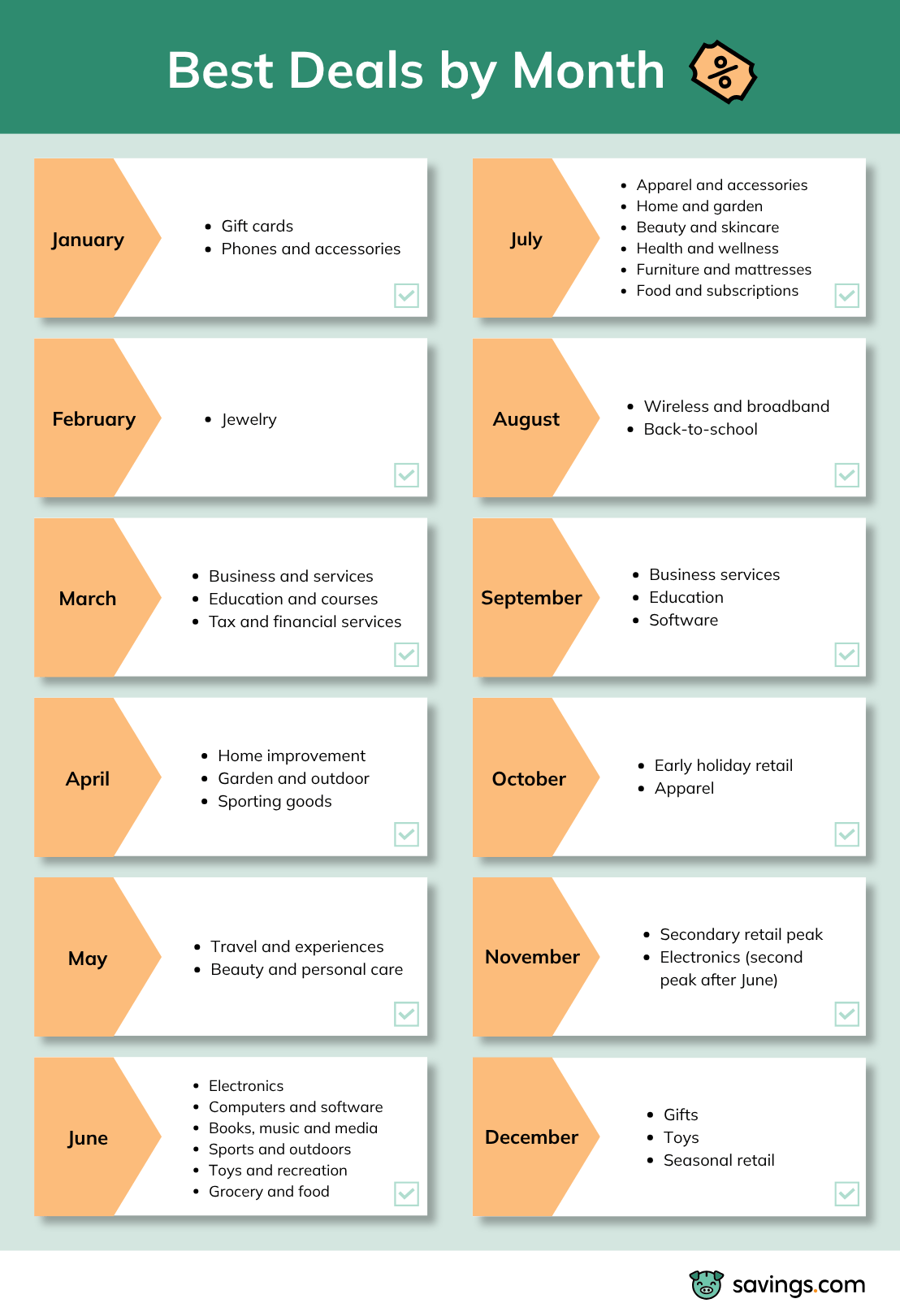
A quick note on how to read this calendar: these rankings reflect when the highest volume of deals becomes available, which means more options to choose from and a greater chance of finding a great price. It doesn't guarantee that every individual deal in June will beat every Black Friday deal. But the odds of finding what you're looking for are significantly better during these peak windows.
Two months completely dominate this calendar. June captures the tech, media, and general retail peaks, while July takes over for lifestyle, home, apparel, and beauty. Together, they account for the majority of category-level peaks across the entire year.
November? It shows up as a secondary peak at best. And in most categories, the deal supply you'll find in November doesn't come close to what was available over the summer.
Best Deals by Month
Based on the number of available deals in each category
| Month | Top deal categories |
|---|---|
| January | Gift cards, phones and accessories |
| February | Jewelry |
| March | Business and services, education and courses, tax/financial services |
| April | Home improvement, garden and outdoor, sporting goods |
| May | Beauty and personal care, travel and experiences |
| June | Electronics, computers and software, books/music/media, sports and outdoors, toys and recreation, groceries and food |
| July | Apparel and accessories, home and garden, beauty and skincare, health and wellness, furniture and mattresses, food and subscription services |
| August | Wireless and broadband, back-to-school categories |
| September | Business services, education, software |
| October | Early holiday retail ramp, apparel |
| November | Broad retail (secondary peak), electronics (secondary, lower than June) |
| December | Gifts, toys, seasonal retail |
Source: Savings.com deal database
Three Shopping Myths Our Data Busts
Our analysis challenges three assumptions that many shoppers treat as gospel. Each one is widely repeated in shopping guides, echoed in media coverage and reinforced by years of consumer habit. And each one falls apart when you look at the actual deal data.
Myth #1: Black Friday Is the Best Time for Deals
The first thing you'll notice in the heatmap below is that Black Friday (the day after Thanksgiving) and Cyber Week (the week after Thanksgiving) aren't the only highly concentrated deal periods on the calendar. In fact, the June and July columns are the most saturated with deals across the widest range of categories. Black Friday still shows strong activity, but it shares that intensity with a summer window that most shoppers aren't even paying attention to.
The numbers confirm what the heatmap suggests. Black Friday week ranks eighth out of 49 weeks in our analysis, with 222,508 total deals. That's nearly 15,000 fewer than the year's top-performing week. The five highest-volume deal weeks are all concentrated in a six-week summer window, with no major shopping holiday attached to any of them:
- June 9 to 15
- June 16 to 22
- July 14 to 20
- July 21 to 27
- July 7 to 13
Cyber Week, the major shopping week after Thanksgiving, ranked sixth among all weeks of the year for deal saturation. It actually outperformed Black Friday in terms of deal frequency, but it still couldn't match any of the summer weeks in the top five. In total, seven of the 10 highest-volume weeks fall between June and early August. Only two holiday-affiliated weeks cracked the top 10, and neither one claimed the top spot.
So what's really happening on Black Friday? The data points to a provocative conclusion: Black Friday is when attention peaks, not when deals peak. Retailers don't need to flood the market with promotions in November, since consumer demand is already at its peak. The promotional push happens earlier in the year, when retailers need deals to create demand rather than just ride it.
Myth #2: Shop When You Need It, and Deals Will Be There
Many of us shop on instinct. We buy electronics for holiday gifting, flowers before Mother's Day, and groceries around Thanksgiving. It feels logical, but the data says this approach means you're consistently shopping during lower-supply windows.
Here's when deals actually peak for every category in our analysis:
| Category | Months with the most deals |
|---|---|
| Baby and nursery | June |
| Books, music, and video | June |
| Groceries | June |
| Wireless, broadband, and cable | June |
| Apparel and accessories | July |
| Automotive | July |
| Beauty | July |
| Electronics | July |
| Food and beverage | July |
| Health and medicine | July |
| Home and garden | July |
| Photo printing | July |
| Sports and recreation | July |
| Travel | July |
| Gift cards | August |
| Arts and entertainment | October |
| Business | October |
| Computers and software | October |
| Education and training | October |
| Flowers and gifts | October |
| Holiday and seasonal | December |
| Toys and games | December |
Source: Savings.com deal database
The pattern jumps off the page: 14 of 22 categories peak in June or July. Zero reached their peak in November.
Some of these mismatches are staggering. Electronics, the single category most synonymous with Black Friday doorbuster culture, peaks in July. That's a full five months before the holiday shopping season. Toys and games, another popular holiday shopping category, peaks in December. However, summer is nearly as strong for toy deals as the holidays. And grocery deals peak in June rather than around Thanksgiving, upending the assumption that food deals concentrate around America's biggest cooking holiday.
Other mismatches run in the opposite direction. Flower and gift deals peak in October, well after Valentine's Day and Mother's Day have passed. This suggests that retailers use fall promotions to drive baseline demand during what would otherwise be a quiet stretch for the category, rather than competing on price during high-demand holidays when people are already buying. Travel deals peak in July, after most spring travel planning is already wrapped up. And five categories peak in October, hinting at an early-holiday promotional ramp that further diminishes November's significance.
The takeaway? The most effective deal-hunting strategy is counterintuitive. Buy when attention is low, not when it's high. Retailers use promotions to create demand during slower periods, which means the shopping calendar most of us follow is essentially inverted.
Myth #3: Post-Holiday Sales Ramp Up in January
We hear it every year: "If you missed the holiday sales, don't worry. January clearance is just around the corner." It sounds reassuring, but our data tell a different story. Deal volume actually declines from December into January and continues to fall into February. The post-holiday period doesn't represent a second wave of promotions. Instead, it marks the lowest ebb of the retail promotional calendar according to our data.
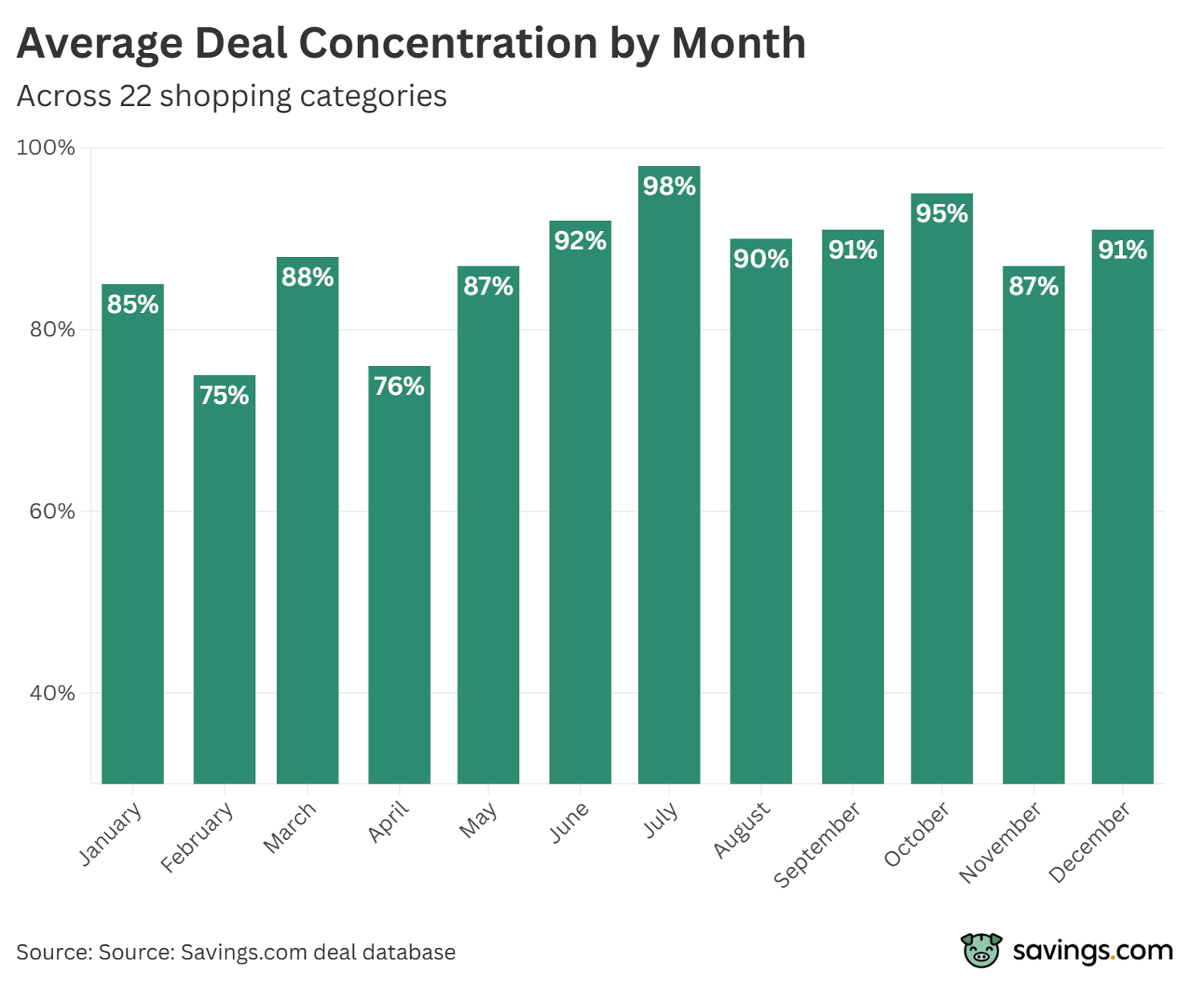
This has real consequences for shoppers who delay purchases in hopes of post-holiday bargains. While individual clearance deals certainly pop up, the overall supply of promotions declines after the holidays rather than expanding. If you're banking on January sales, you're operating in a lower-supply environment than you would have found in June, July, or even November.
The likely explanation? Retailers have gotten much better at managing inventory. Improved demand forecasting means less overstock after the holidays, which translates to fewer clearance promotions. The era of massive January blowout sales is fading.
Several forces are likely driving this shift. Amazon Prime Day, which typically falls in June or July, has exerted a gravitational pull across the retail landscape, prompting competitors across categories to launch their own summer promotions. Add in mid-year inventory clearances and the need to generate foot traffic during traditionally slower summer months, and you get a promotional environment that reaches full intensity well before the holidays.
What This Means for Deal Hunters
If you've been organizing your biggest purchases around Black Friday and holiday sales, this data suggests a different approach. Here's what we'd recommend:
- Look out for deals on your priciest purchases in summer. The June-to-July window offers the widest selection of deals across the most categories. Whether you're shopping for electronics, beauty products, home goods, or apparel, summer gives you more options to compare and a better chance of finding the right deal.
- Use the calendar above as your buying guide. Each category has its own "secret season," and they don't all line up. Tech and media categories peak in June, while lifestyle, beauty, and home categories cluster in July. Planning around these windows puts you ahead of most shoppers.
- Don't skip Black Friday entirely, but adjust your expectations. Black Friday still offers real deals, particularly from retailers competing for holiday attention. The point isn't that Black Friday is bad. The point is that it isn't the promotional peak most people assume, and waiting for it often means passing up better opportunities earlier in the year.
- Be skeptical of January "clearance" hype. Post-holiday deal volume actually declines, so if you're holding out for January bargains, you may be shopping in one of the lowest-supply windows of the year.
The emergence of a summer deal season has implications that go beyond your personal shopping list. If retailers continue concentrating promotions in June and July (likely accelerated by Amazon Prime Day's growing influence), we could see a permanent restructuring of the retail promotional calendar. Black Friday may evolve into a purely demand-driven event: a moment of cultural shopping momentum in which retailers capture volume without having to offer their best promotional supply.
Methodology
This study uses a descriptive, observational design to examine the seasonality of promotional deals using platform-based data from Savings.com, a digital platform aggregating online coupons and promotions.
Sample: 10,641,215 total deals observed between May 1, 2025, and April 30, 2026, spanning 22 major retail categories (refined from 39 in the raw dataset after excluding micro-categories with negligible deal volume).
Analytical approach: We evaluated deal volume using two complementary measures. Absolute counts (total deals per time period) identified periods of high overall promotional activity and ranked weeks and months by raw deal supply. Relative intensity (normalized within each category to its own peak) identified category-specific peak periods that may not be visible in aggregate trends alone.
Key definitions: Black Friday week is defined as the week starting Nov. 24, 2025. Cyber Week is defined as the week starting Dec. 1, 2025.
Limitations: Deal counts reflect promotional offers aggregated by Savings.com and may not represent the complete universe of retail deals. The analysis measures deal volume, not discount depth. Category peaks are based on normalized intensity, meaning small categories carry equal weight in category-level comparisons. The dataset covers a single 12-month period, so that year-over-year trend comparisons would require additional data. No consumer behavior data (clicks, conversions, or purchases) is included; findings reflect only supply-side promotional activity.