

October 8, 2026
Most shoppers will let AI help them hunt for Cyber Week deals and holiday gifts, but some still hold out: nearly 1 in 5 people would rather get no gift at all than one that involves AI.
Key Findings
- AI has become a default holiday shopping tool. 77% of shoppers expect to use an AI tool or AI-powered search to find Black Friday or Cyber Monday deals and gifts this year.
- However, many won’t admit they used AI to research gifts. 36% of AI shoppers say they'd be unlikely to tell anyone they used AI to help choose a gift or make a purchase.
- Shoppers are willing to trade their data for tailored shopping recommendations: 72% of respondents are somewhat or very comfortable with AI using their purchase history or browsing behavior to serve up better recommendations.
- The youngest shoppers are the most AI-averse. 67% of adults 18–24 would have a negative reaction to an AI-generated gift, such as art or a poem, versus 26% of those 55+. And 36% of young adults would rather get no gift than one involving AI, compared with 18% of the general public.
- Consider the recipient when using AI for gift brainstorming. Only 7% of people would mind if their boss used AI to pick their gift, but 34% would object if it were their spouse or partner.
As the 2026 holiday season approaches, AI has become an essential tool for shoppers searching for deals and recommendations. Retailers saw referral traffic from generative-AI tools jump nearly 700 percent year over year last holiday season, and the biggest AI platforms now let you buy without leaving the chat window. OpenAI added an in-chat "Instant Checkout" button to ChatGPT in late 2025. Heading into the busiest shopping stretch of the year, the question isn't whether people will use AI to find gifts and deals. It's how they’ll use it, whether they'll admit it, and how they'll feel when the present under the tree was picked, or made, by a machine.
To find out more about how AI is shaking up holiday gift-giving traditions, Savings.com surveyed 1,603 U.S. adults in September 2026 about how they use AI to shop and what they really think about AI-selected or AI-generated gifts. In short: most shoppers are all-in on AI as a research assistant for holiday deal-seeking and gift inspiration, but the young adults are much more likely to resist AI in the gift-giving process than their elders.
AI Is Now a Standard Research Tool for Black Friday and Cyber Week
More than three in four shoppers expect to lean on AI for holiday shopping this season, and only 8 percent will avoid it entirely. A couple of years ago, AI was a novelty a few early adopters played with. For many, it's a default research step, much like how price-comparison sites and coupon codes have become routine. And with 65 percent of adults planning to shop Cyber Week, a lot of that AI use is about to happen at once.
| Do you expect to use an AI tool or AI-powered search result to help with holiday shopping, Black Friday, or Cyber Monday purchases this year? | Percentage of respondents |
|---|---|
| Yes, definitely | 21% |
| Yes, probably | 57% |
| No | 8% |
| Not sure | 15% |
| Yes (net) | 77% |
Source: Savings.com survey of 1,603 U.S. adults, 2026.
What's striking is how much access shoppers are willing to give artificial intelligence platforms. Seventy-two percent say they're somewhat or very comfortable with AI using their purchase history or browsing behavior to serve up better recommendations. That's a lot of permission given during a time of distrust in AI. In a February 2025 survey reported by Chain Store Age, 58 percent of shoppers said they were worried about how AI handles their personal data. When there's a deal on the line, though, convenience may win out over worry.
Willingness to use AI to surface deals is not the same as blind trust, however. Nearly half of AI shoppers (48 percent) say they'd verify deals or promo codes surfaced by AI on another site before buying. They know a code can be expired or the fine print can exclude what’s in the cart. Unfortunately, AI isn’t ready yet to verify deals and discounts perfectly.
The Emotional Reaction to AI-Chosen Gifts
If shoppers are comfortable letting AI find Cyber Week deals, they're more divided about letting it into the gift selection itself. Of all shoppers who use AI, about 36 percent said they would be unlikely to admit they chose a gift using AI, which suggests some feel shame about using AI for gift guidance.
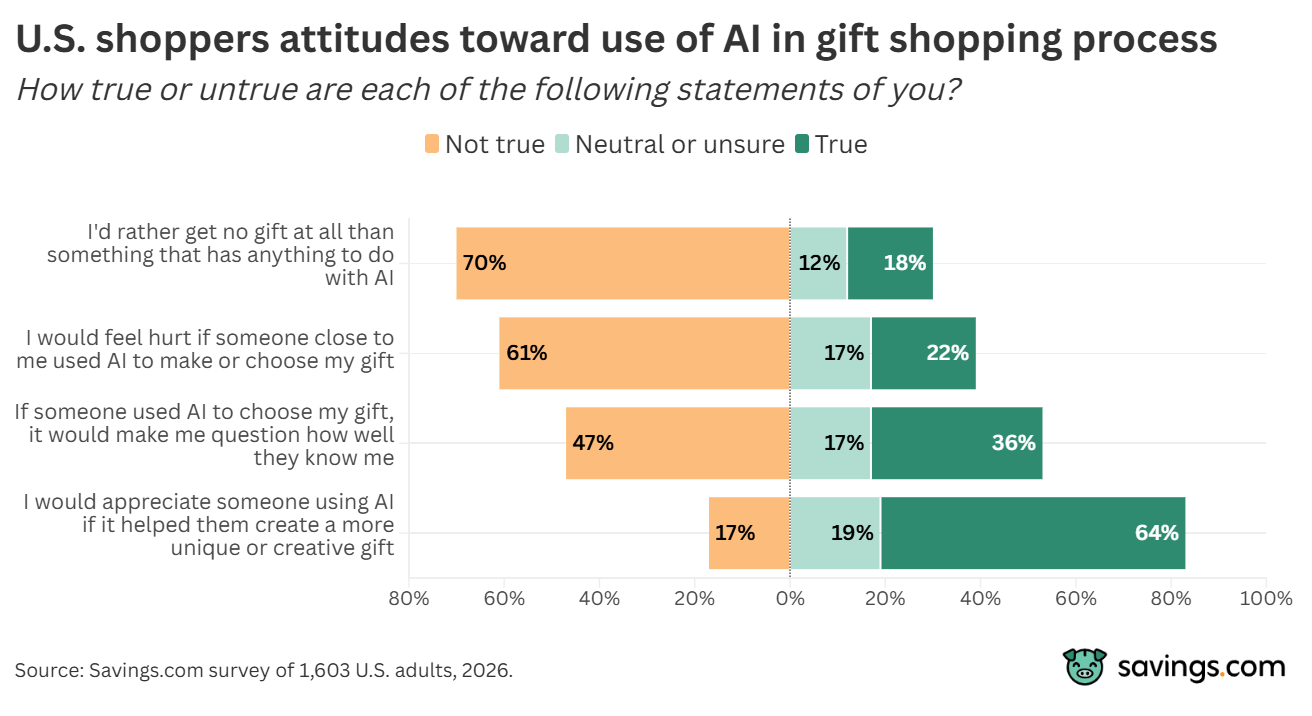
Nearly 1 in 5 (18 percent) respondents say they'd rather get no gift at all than one that involves AI. That's a small share, but it’s a large enough group that gift-givers should consider the recipient carefully before using AI to choose their present. More than a third of respondents (36 percent) say an AI-chosen gift would make them question how well the giver actually knows them, and 22 percent would feel hurt if someone close to them used it.
But the same table shows that people are more likely to be enthusiastic about AI in the gift-shopping process: 64 percent say they'd appreciate AI if it helped come up with a more unique or creative gift. Put those together, and the line people are drawing comes into focus: they aren’t totally against AI, but they want to know effort or thoughtfulness went into selecting their gifts. A gift-giver who used AI to be more creative isn't the same as one who used AI to skip the thinking altogether.
Some age groups reacted more strongly to AI as a gift-research tool than others. Among adults 18–24, 36 percent would rather get no gift than one involving AI, versus 18 percent of the general public and 9 percent of people 55 or older. More than half of respondents aged 18-25 said it would make them question how well the giver knows them if they used AI to help choose the gift, compared to 28 percent of older adults.
Older shoppers were more open to AI-assisted gift-giving, too: 73 percent of those 55+ would appreciate AI that helped make a more creative gift, compared with 47 percent of those 18-24.
Are People Embarrassed to Use AI for Gift Suggestions?
Most people don't see reaching for AI as something to be ashamed of. Many see it as just another research tool. According to our study, only 12 percent said using AI to help choose gifts was lazy or less thoughtful. Nearly half (48 percent) said it's fine to use AI as a starting point, and 33 percent described it as helpful, like asking a friend for a recommendation.
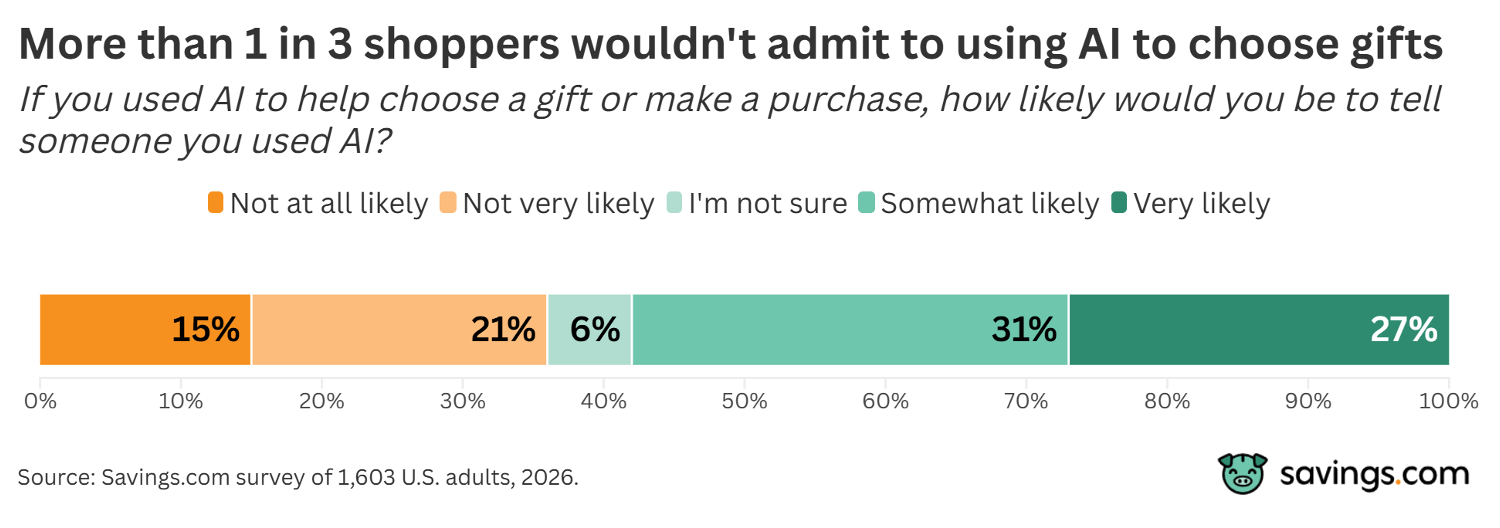
Even so, plenty keep it to themselves. More than a third of AI shoppers (36 percent) say they'd be unlikely to tell anyone they used AI. It's a tool people are happy to use but not always to credit, a little like looking up the answer before trivia night. Most would still fess up, but a sizable group is quietly treating AI help as its own small secret.
However, we found that objection to using AI for gift ideas rises with intimacy. Almost nobody minds if a boss or coworker leans on AI for gift ideas for a teammate, with just 7 percent and 8 percent objecting, respectively. Because work colleagues are less likely to know one another’s personal lives, it may be more acceptable to use AI to come up with a suitable gift.
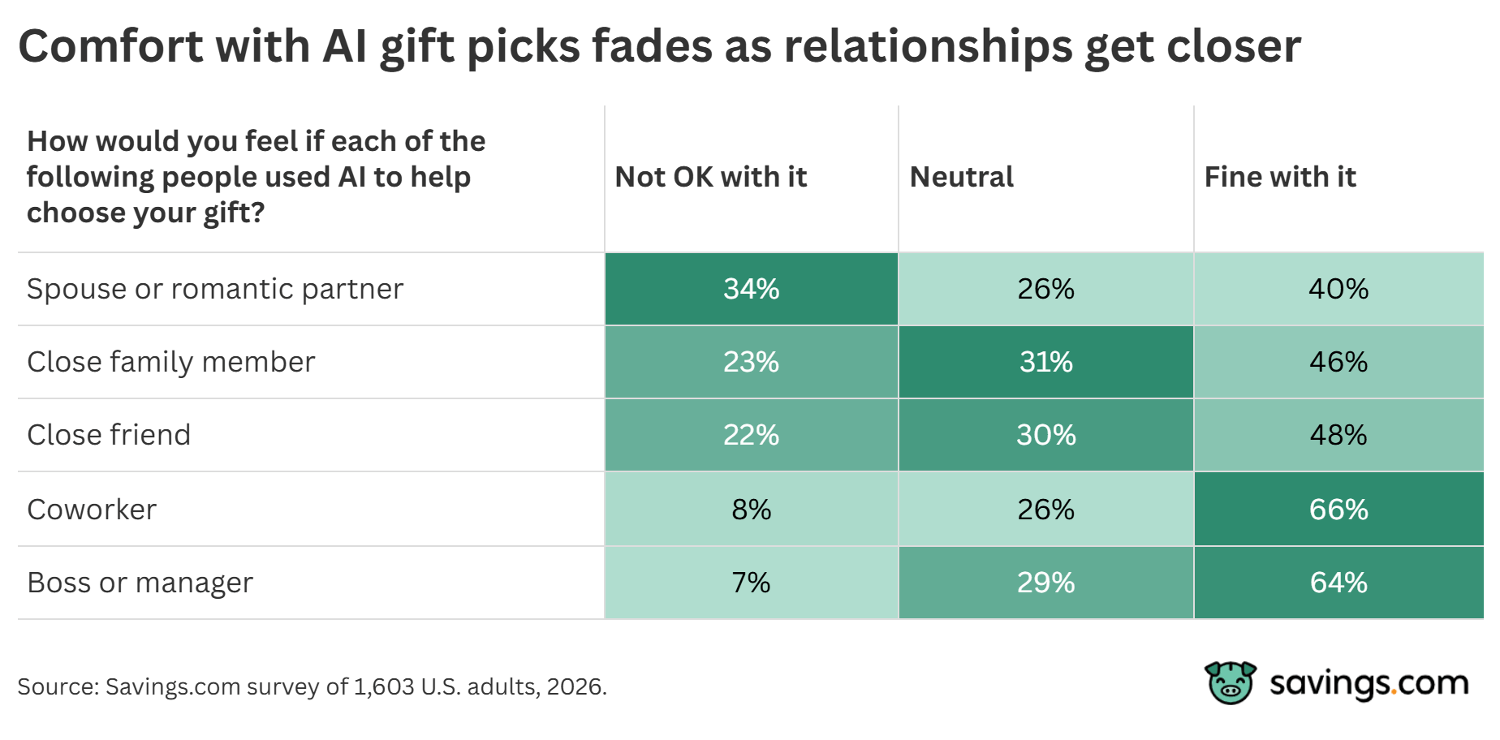
However, when there is an expectation of closeness in a relationship, attitudes toward AI inspiration soured a bit. About one in five people in our study aren't OK with a close friend or family member using AI for gift suggestions. Get all the way to a spouse or romantic partner, and 34 percent object, nearly five times the rate for a boss. The closer the bond, the more an AI shortcut feels like one. This trend was even more pronounced among the youngest respondents in our study: 47 percent of adults 18–24 object to a spouse using AI for a gift idea, versus only 28 percent among respondents aged 55 or older.
Even though half of U.S. adults tell Pew Research Center they're more concerned than excited about AI in daily life, many of our survey respondents said they’d feel curious if they learned someone used AI to help choose their gift. Forty-one percent would want to know what the tool suggested, and a third said they’d feel appreciated or cared for. Only 14 percent said they’d feel less special, and just 5 percent would be creeped out. Again, younger respondents were more likely to harbor negative sentiment about AI gift selection: 32 percent of adults 18–24 would feel less appreciated if someone used AI to help choose their gift, versus only 8 percent of those 55+.
Opinions Are More Split on AI-Generated Gifts
Our survey revealed one key difference between attitudes toward AI surfacing deals and suggesting gift ideas and AI actually making the gift. When the machine only helps pick a gift, reactions skew curious and warm. When the machine actually produces the gift, such as an AI-generated image, song, poem, or video, opinions start to split. Sentiment also split by age: 67 percent of adults 18–24 said they’d have a negative reaction to receiving an AI-generated gift, versus 26 percent of those 55 or older.
| If someone gave you a gift created with AI (AI-generated art, a song, poem, or video), which words describe your reaction? | Percent of respondents |
|---|---|
| Appreciated | 29% |
| Amused | 27% |
| Disappointed | 27% |
| Curious | 23% |
| Awkward | 21% |
| Neutral | 20% |
| Impressed | 16% |
| Uncomfortable | 16% |
| Touched | 14% |
| Offended | 10% |
| Not sure | 5% |
Source: Savings.com survey of 1,603 U.S. adults, 2026. Multiple responses allowed.
Thirty-eight percent report at least one negative reaction, including disappointment, discomfort, awkwardness, or offense. That roughly matches the 36 percent who would have a positive reaction, such as appreciation or being impressed. People may be more likely to accept AI as a research assistant but become uncomfortable when it takes on the role of artist, a sentiment that’s not limited to gift-giving: Coca-Cola drew a second straight year of public backlash over its AI-generated Christmas ads in November 2025, with critics calling the spots "soulless."
Is AI-Assisted Gift Giving Here to Stay?
Most shoppers are fine with AI helping them choose holiday gifts for friends and family, and recipients are more likely to be curious than offended by such presents. Still, they're more likely to be wary of AI generating the actual gifts, such as custom art, letters, or songs, especially if they’re members of Gen Z. Furthermore, enthusiasm for AI-driven gift choices drops significantly when recipients expect the giver to hold enough personal insight to select a meaningful present on their own, without automated assistance.
The takeaway for shoppers is simple enough. Using AI to research gifts and hunt deals is now normal and well-accepted. With 48 percent double-checking deals surfaced with AI tools, it's also smart to stay a little skeptical. Just remember what the data says about the gift itself. Let AI help you think, not think for you. Consider the recipient when leveraging AI for gift research and gift-giving. The research is clear: younger adults are much more likely to react negatively to AI in the gift-giving process and strongly prefer a more personal touch.
Methodology
This survey was conducted online in September 2026 among a sample of 1,603 U.S. adults. The sample was designed to represent the American adult population by age, sex, and ethnicity. Respondents answered questions about their use of AI for online shopping, Black Friday/Cyber Monday planning, deal and discount behavior, trust in AI shopping recommendations, and attitudes toward AI-assisted and AI-generated gifts. Percentages may not add to 100 percent due to rounding. Multiple-response questions can exceed 100 percent because respondents could select more than one answer.