

January 20, 2026
As Valentine's Day expenses rise 30% in five years, Americans say the gifts they want most cost nothing at all.
Key findings
- Valentine's Day costs have risen 30% in five years, outpacing general inflation, and 46% say rising costs are making the holiday harder to celebrate.
- 26% of Americans feel pressured to spend money on Valentine's Day, and 2 in 3 Americans believe the holiday has become “too commercialized."
- What people actually want doesn't cost much: 48% say quality time at home with their loved ones is their preferred Valentine’s Day gift, and 43% prefer experiences over physical presents.
- Spending peaks early in relationships—couples together less than a year budget $150 for Valentine’s Day, dropping to $100 in relationships of five years or longer.
- Younger generations are redefining the holiday: Gen Z leads in spending on friends and self, and over 20% of single Gen Zers celebrate alternative holidays like Galentine's and Palentine's Day.
Valentine's Day in 2026 looks dramatically different from just five years ago. Americans are celebrating the holiday in new ways, driven by both economic pressures and shifting relationship norms. According to our analysis of Consumer Price Index data, Valentine's Day costs have risen by roughly 30 percent since 2021, outpacing general inflation. At the same time, the holiday itself is expanding beyond romantic couples to include friends, family, and self-celebration.
How Much Americans Plan to Spend—and Who's Over Valentine's Day
According to our January 2026 survey of 2,455 U.S. adults, three-quarters of Americans plan to spend money on Valentine's Day this year, with a typical budget of $125. While most people expect to spend about the same as last year, 17 percent anticipate spending more. But these top-line numbers mask a striking divide: men plan to spend roughly 40 percent more than women, budgeting around $150 compared to women's $105.
| Gender | Median planned spending |
|---|---|
| All adults planning to celebrate | $125 |
| Men | $150 |
| Women | $105 |
More than half of Americans will buy gifts or meals for a romantic partner, but increasingly, Valentine's Day spending extends to children, family, and friends. Notably, 14 percent say they'll treat themselves to a Valentine's gift—a reminder that the holiday is no longer exclusively about romantic love.
Yet the most revealing statistic may be this: one in four Americans won't spend a single cent.
| Who will you spend money on this Valentine’s Day? | Percent of adults | Typical planned spending among those planning gifts |
|---|---|---|
| Romantic partner | 55% | $100 |
| Children | 22% | $50 |
| Myself | 14% | $40 |
| Friends | 9% | $65 |
| Not spending on anyone | 25% | - |
Nearly half of single adults (49 percent) are opting out entirely, suggesting that participation in Valentine's Day is often tied to relationship status. But economics matter too. Lower-income households are twice as likely to skip spending compared to those earning $75,000 or more. This creates a financial participation divide, where Valentine's Day becomes less a universal celebration and more an optional event that not everyone can afford to join.
For some, opting out may be a matter of budget constraints amid rising costs. For others, it's a rejection of a holiday they see as exclusionary or overly commercial. Either way, the data challenges the notion that Valentine's Day is a universal cultural moment.
Romantic Spending Peaks Early—and Declines With Time
Among those spending on romantic partners, the typical budget is around $100, with men again spending significantly more than women. However, the most interesting pattern emerges when examining spending by relationship length: it declines steadily as relationships mature.
Valentine’s Day spending on romantic partners, by relationship length
| Relationship length | Typical spending |
|---|---|
| Less than 1 year | $150 |
| 1–4 years | $125 |
| 5+ years | $100 |
In relationships less than a year old, typical spending hits $150. By the one- to four-year mark, it drops to $125. After five years together, couples spend around $100. This pattern challenges the assumption that longer, more serious relationships mean bigger Valentine's Day gestures. Instead, the data suggests a more nuanced reality: as emotional security deepens, the need for performative spending may diminish.
Valentine’s Day Spending Breakdown
When Americans do spend on Valentine's Day, dining out dominates. The typical person budgets $60 for romantic restaurant meals or cozier takeout dishes, making experiences the clear priority. Gifts such as jewelry, clothing, and accessories come in second at $45, followed by decor and party supplies at $25.
| Valentine’s Day spending category | Typical spending per person* |
|---|---|
| Dining out or takeout | $60 |
| Gifts (jewelry, clothing, accessories) | $45 |
| Decor and supplies | $25 |
| Chocolate or candy | $16 |
| Cards | $1 |
| Flowers | $0 |
*Among those who spend money in these categories
But traditional Valentine's symbols are fading fast. The median spending on cards is just $1, and for flowers, it's $0. This doesn't mean no one buys flowers—instead, it means the typical American no longer sees them as a core part of their Valentine's Day budget.
This shift mirrors broader consumer trends favoring experiences over goods. It also reflects economic pragmatism: with restaurant prices climbing and budgets stretched, people are making trade-offs. A nice dinner feels special, but fleeting. Flowers wilt. Cards get recycled. In an era of inflation and minimalism, experiential gifts are gaining ground over symbolic consumption.
Valentine's Day Is No Longer Just for Couples—and Singles Are Rewriting the Rules
The traditional Valentine's Day script is being rewritten by a growing number of Americans who are celebrating friendship instead of romance. Galentine's Day, which celebrates female friendships, and Palentine's Day, which celebrates friends of any gender, are gaining mainstream traction as alternatives to the couples-focused holiday.
| Group | Percent of singles celebrating Galentine’s or Palentine’s |
|---|---|
| Women | 16% |
| Men | 6% |
| Gen Zers (18-28) | 21% |
| Millennials (29-44) | 15% |
| Gen Xers (45-60) | 9% |
| Baby Boomers (61-79) | 3% |
About eight percent of all U.S. adults now celebrate these alternative versions of Valentine's Day, but the trend skews dramatically younger. More than 20 percent of single Gen Zers participate, compared to three percent of Baby Boomers. Single women are particularly likely to embrace the tradition, with 16 percent celebrating compared to just six percent of single men.
The trend has been growing steadily in recent years. First popularized by the show “Parks and Recreation," the Telegraph reported in early 2025 that "unlucky-in-love Gen Z" are increasingly swapping Valentines for Galentines (and Palentines).
Typical spending on these alternative celebrations is around $50—less than traditional Valentine's budgets, but still meaningful. For many singles, these events provide an opportunity to participate in the holiday regardless of relationship status. They're social, often more affordable, and reflect a broader cultural shift toward valuing friendships and chosen family.
Pressure, Stress, and Inflation Are Reshaping the Holiday
More than a quarter of Americans feel pressured to spend money for Valentine's Day, and around one in five report feeling stressed about it. These numbers are highest among younger adults and those in newer relationships—groups already navigating other sources of financial and emotional pressure.
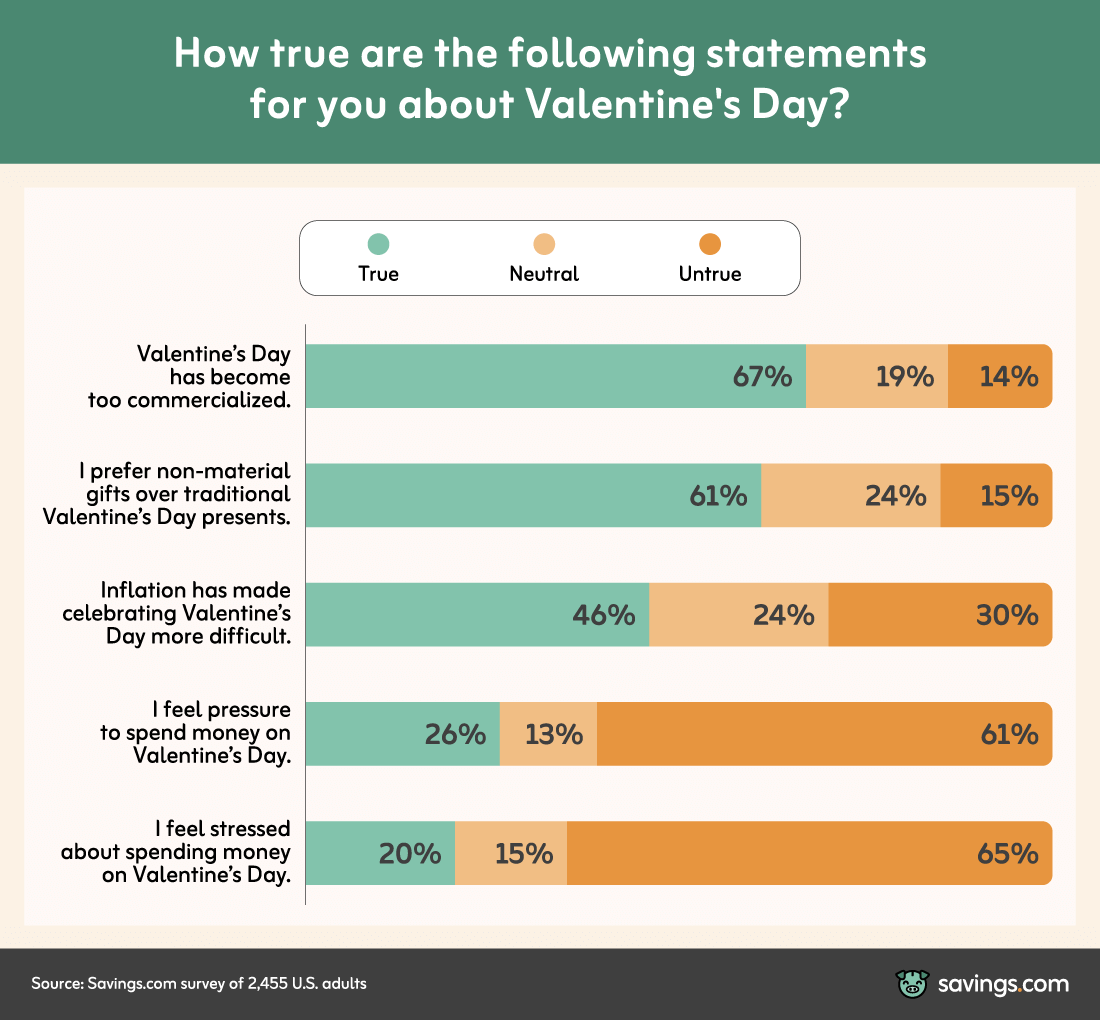
And it's not just psychological: 46 percent say inflation is making it harder to celebrate Valentine's Day. Over the past five years, Valentine's Day costs have risen roughly 30 percent, according to our analysis of Consumer Price Index data, outpacing general inflation. Restaurant prix-fixe menus, specialty chocolates, and even greeting cards cost more, straining budgets that were already tight.
This economic pressure helps explain why so many Americans are seeking alternatives, whether that means opting out entirely, expanding the holiday beyond romantic partners, or choosing more heartfelt, non-material gifts.
What Americans Actually Want for Valentine’s Day
When asked what they actually want for Valentine's Day, Americans overwhelmingly favor non-material gifts and gestures. Quality time at home was a favorite way to spend Valentine's Day for nearly half of all adults, and 43 percent of them considered special experiences, such as vacations or cooking classes, among their favorite gifts. In fact, fewer than one in three people chose physical gifts like chocolates or jewelry among their favorite things to receive on Valentine’s Day.
| What types of gifts or gestures do you personally value receiving most for Valentine’s Day? Select up to three. | Percent of respondents |
|---|---|
| Quality time at home | 48% |
| Experiences (i.e., trips) | 43% |
| Words of affirmation (i.e., love note) | 35% |
| Traditional gifts (such as flowers, chocolates) | 31% |
| Homemade or personalized gifts | 24% |
| Acts of service (such as household chores, childcare) | 17% |
| Do not want anything | 17% |
This pattern holds across generations, though with some variation. Gen Z and Millennials showed the strongest preference for experiences and homemade gifts, while Boomers are most likely to say they don't want anything at all. Across all age groups, quality time at home with partners, children, or friends consistently ranks as the most desired gift.
The Worst Valentine’s Gifts Reveal What People Actually Care About
When Americans recall their worst Valentine's gifts, the complaints are vivid—and revealing. One respondent got "a watch from the pawn shop that turned my wrist colors." Another said," An ex-boyfriend once regifted me flowers that his father had given his mother."
| What was the worst Valentine’s Day gift you’ve ever received? | Percent of respondents |
|---|---|
| Odd or random items | 33% |
| Candy or chocolate with quality issues | 17% |
| Generic, blank, or impersonal cards | 11% |
| Cheap or last-minute gifts | 9% |
| Wilted, rotten, or regifted flowers | 8% |
| No gift (forgotten) | 8% |
A third of responses describe odd or random items that missed the mark entirely. But the common thread across all categories isn't price—it's thoughtlessness: "A card he didn't even bother to sign." "Gas station flowers as an afterthought." "A single box of those gross chalky 'candy' hearts." Even practical gifts fell flat: "I received a vacuum cleaner once from my husband as a Valentine's gift."
Perhaps most telling, nearly eight percent said the worst gift was no gift at all. The message is clear: Valentine's Day isn't about expensive gestures, especially as cost pressures continue to strain Americans’ wallets. It's about showing that you paid attention, put in effort, and remembered the people you love most.
Methodology
In January 2026, Savings.com polled 2,455 American adults about their personal plans and preferences around Valentine's Day. The poll was conducted online. The sample was constructed to be representative of the age, sex, and ethnicity of the U.S. population according to the Census.
The median annual household income for this group was $50,000 - $74,999 per year. Single adults made up 36 percent of the sample, 21 percent were dating or engaged, and 43 percent were married or in a civil union. For those dating, engaged, or married, 54 percent had been in their relationship for more than 10 years, 16 percent had relationships of five to nine years, and 30 percent were in relationships of less than five years.